



Three Things We’re Hearing
- The Bundle Wars! Two Playbooks, One Battlefield
- Small Business Credit Cards — A Trillion-Dollar Market!
- Personal Loan Originations Lead 2025 Growth
A four-minute read
If you would like the Epic Report delivered right to your inbox, click here
The Bundle Wars: Two Playbooks, One Battlefield
- Product bundling has moved from a feature to a part of the core acquisition architecture in consumer finance — but fintechs and commercial banks are running fundamentally different playbooks
FINTECHS BUILD PRODUCTS THAT NEED EACH OTHER
- SoFi launched in 2011 with student loan refi, and today spans loans, cards, deposits, brokerage, and robo-advisory in a single app
- SoFi Plus requires a $10/month subscription
- Bundling incentives include a $400 credit on a Home Equity loan for SoFi Plus members (31% off $1,295 fee)
- In addition to the Home Equity discount, members get high-interest rates (4.50% APY on savings as of 3/31/26), overdraft protection, and exclusive rewards
- Any product unlocks pricing benefits across others, engineering a built-in dependency

- Robinhood Gold Card (3% uncapped cash back) is tethered to brokerage
- Full-value redemption requires deposit into a Robinhood investing account, with statement credits redeeming for less
- The card also requires a $50/year Gold subscription
- Robinhood has issued over 700,000 Gold Cards that have already generated over $10 billion in annualized spend

- Apple Card has a similar method of keeping their rewards in their ecosystem, routing their Daily Cash rewards into Apple Cash or an Apple Savings account

- Fintech Pattern: rewards, pricing, and utility are non-portable by design
COMMERCIAL BANKS TYPICALLY LAYER REWARDS ON TOP OF STANDALONE PRODUCTS
- Bank of America has announced they are replacing their current card rewards program — Preferred Rewards — with BofA Rewards
- The new program will provide tiered card rewards levels based on deposit balances across BofA products
- The new program eliminates the previous $20,000 deposit minimum which opens eligibility to ~30 million additional clients in addition to the 11 million in the program today
- Tiers deliver 10%–75% card rewards bonuses, plus loan discounts and other benefits
- The 75% tier now requires $1 million in minimum account balances, up from the previous $100,000 minimum

- Wells Fargo, JPMorgan Chase, and Citigroup run similar balance-tier models

- Commercial Bank Model: products stand alone; bundling is incremental pricing upside for the consumer
THE STRUCTURAL DIFFERENCE MATTERS
- Fintech Model: not utilizing any one product measurably degrades the value of the others — the bundle is the moat

- Bank Model: every product still works alone; the value is in adding products to elevate tiers and benefits

- Fintechs use cards and high-yield checking as acquisition vehicles for deposit and investment relationships; banks use balance tiers to expand wallet share among customers they already have
WHAT’S NEW
- BofA removing the $20K floor indicates that relationship pricing is moving down-market — the funnel expands, but architecture doesn’t change
- The fintech advantage is structural, not promotional
- Interlocking products raise switching costs without explicit friction
- Bank rewards are portable; fintech rewards are captive
- Acquisition economics are shifting
- Cross selling additional products to existing customers is much less expensive than new customer acquisition
- The saved acquisition expense can be directed toward consumer value that helps embed retention into the relationship
- The retention delta is real — multi-product users consistently show higher engagement and lifetime value vs. single-product users
BOTTOM LINE
- The battlefield is shifting from pricing to structure
- Fintech bundles increase the cost of leaving
- Bank bundles increase value — but don’t prevent exit
- The winner won’t be who offers the richest bundle — it will be who makes the bundle hardest to leave
Small Business Credit Cards: A Trillion-Dollar Battleground
- We’re asked frequently about small business credit card acquisition which is challenging outside of branches as direct mail lists for small businesses are generally much smaller and less targeted than those sourced from credit bureaus for consumer cards
THE SMALL BUSINESS CARD MARKET IS BIGGER THAN MOST MARKETERS REALIZE
- U.S. small business (SMB) credit card purchase volume reached $1.02 trillion in 2025 — ~13% of the ~$7.5 trillion total U.S. card spend
- Average monthly spending on each active card reached $24,000 in 2024, driven by migration of operating expenses, office supplies, and other expense categories from ACH to cards

TRADITIONAL CARD ISSUERS STILL OWN THE CORE MARKET
- American Express is the largest US small business card issuer by spend, with 4.3 million customers
- While Amex recently lost the Amazon SMB card to US Bank it still offers 11 different SMB products, including a deep co-brand portfolio with Delta SkyMiles Business, Marriott Bonvoy Business, and Hilton Honors Business

- In March Amex launched a significant expansion of its commercial card portfolio, centered on increased automation, integrated expense management, and a new, Graphite 2% cash-back card
- JPMorgan Chase competes with the Ink Business family (Preferred, Cash, Unlimited), plus the new Sapphire Reserve for Business launched late 2025, backed by the largest small business banking franchise in the country
- Capital One is back in the mail with Spark Cash Plus and Venture X Business
- Bank of America, Wells Fargo, U.S. Bank, Citi, PNC, and Barclays round out the bank issuer set
FINTECHS REWROTE THE RULES AT THE HIGH-GROWTH END
- Fintechs Brex, Ramp, and Mercury unbundled the card from the bank and rebundled it with software — real-time spend controls, automated receipts, AP automation, AI-driven policy enforcement
- A recent study of 1,700 tech companies showed Brex and Ramp dominating business credit card adoption in the tech sector, with Amex the lone “traditional” card with significant market share

- To accelerate its expansion into AI-driven business payments and software-based expense management, Capital One acquired fintech company Brex in April for $5.15 billion
MARKETING: BANKS LEAN ON MAIL + BRANCH; FINTECHS ON EMBEDDED
- Branch is still the bank issuers' best weapon — attaching a card to a new business checking account is a structural advantage fintechs cannot easily replicate
- There were 270 million pieces of SMB card direct mail in the 12 months ending in March, with Amex, Chase, Capital One, Wells Fargo, and Citi leading the pack

- Wells Fargo and others concentrated their mail on a single card offering, while Amex marketed six different small business products

- Fintechs win on digital and embedded channels, distributing through QuickBooks, Xero, NetSuite, Gusto, Rippling, and VC partnerships at a fraction of the cost of direct mail
AGGREGATORS: SMALLER ROLE — AND SHIFTING
- Amongst the aggregators, NerdWallet and Bankrate are the two meaningful destinations for SMB cards
- NerdWallet has identified SMB as a strategic growth vertical and offers ~70 business cards on its site
- Credit Karma's TurboTax and QuickBooks tie-ins give Intuit a structural advantage in matching owners to cards at tax filing or accounting setup

- However, the bigger story may be that Gen AI is shrinking organic traffic to comparison sites overall and issuers with direct AI channel access (Chase, Capital One, NerdWallet) are gaining share
THE BOTTOM LINE
- The SMB card market is bifurcating — software-led platforms are taking the venture-backed and tech-forward segment; bank issuers retain the traditional Main Street owner...for now
- Bank issuers must defend the core with branch and mail but invest aggressively in AI, embedded distribution, and co-brand rotation — the Amazon-to-U.S. Bank move proves that even multi-billion-dollar SMB portfolios are now in play
- Capital One/Brex told the rest of the bank issuers what they already knew — if you cannot build the AI-native CFO platform, you will need to buy one

Personal Loan Originations Lead 2025 Growth
- Equifax 2025 credit origination statistics show 15%+ growth in first mortgages and personal loans, modest increases in bankcards and auto loans, and a decline in private label card

- Unsurprisingly, the origination numbers correspond to 2025 direct mail spending volumes which saw personal loan spending up 22% and card spending up 10%
- Rates offered on high yield savings accounts continued their decline, with the average rate now ~50bp lower than one year ago


- Cash App launched a first-of-its-kind feature that converts recent peer-to-peer payments into short-term installment plans — i.e., they will lend you money to pay to an individual
- The launch coincides with Cash App opening P2P send/request to non-users — counterparties no longer need a Cash App account to transact
- Together, the moves position Cash App as the first major U.S. finance app to embed pay-over-time flexibility directly into everyday money movement

- BNPL credit reporting visibility is rapidly expanding as Affirm now reports all loans to Experian and TransUnion
- Klarna began reporting Pay-in-4 transactions to TransUnion and Experian in 2025
- For lenders running underwriting models, BNPL repayment behavior is increasingly visible in consumer credit files — though coverage remains uneven and limited to one or two bureaus per provider
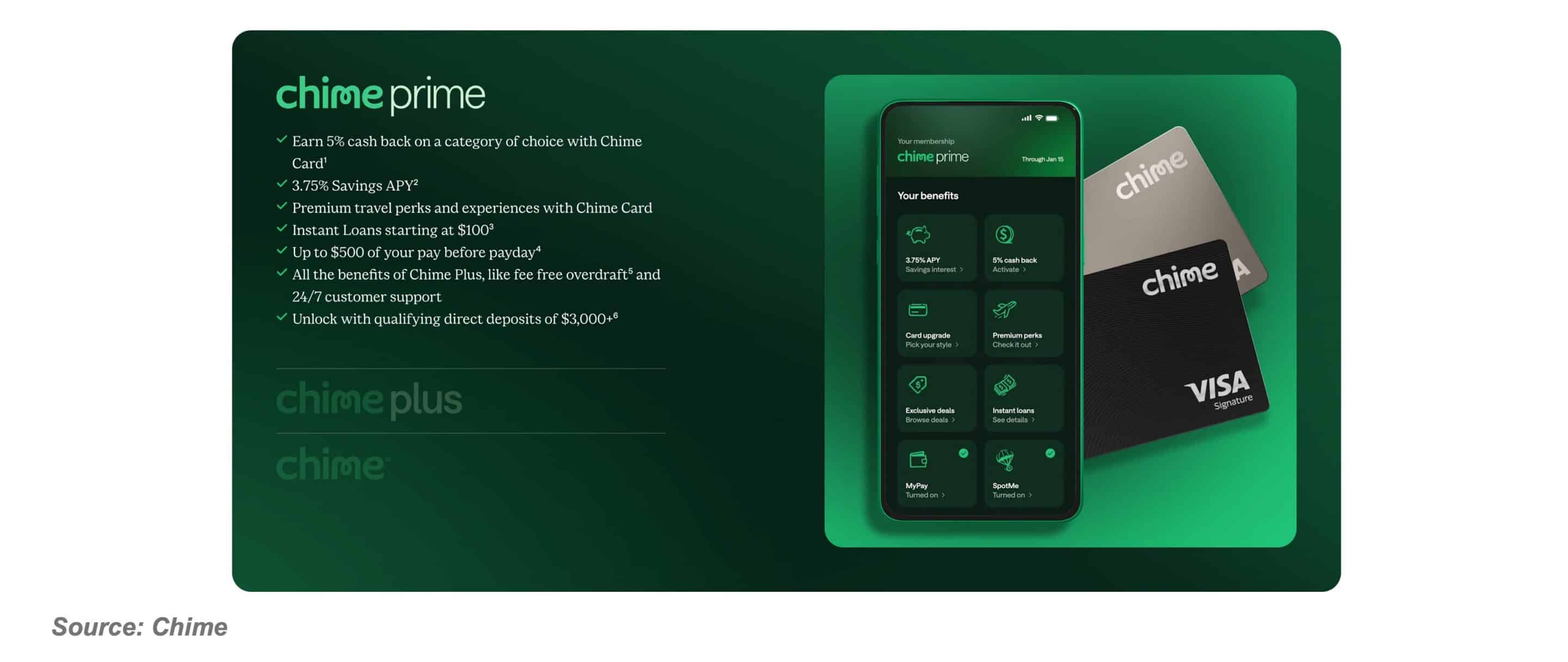
- Chime Goes Full Frontal Assault on Primary Checking, having recently launched Chime Prime, a no-fee premium tier auto-unlocked with $3,000+/month in direct deposits
- The package includes 5% cash back on a chosen category, 3.75% APY on savings, Priority Pass and Visa Signature concierge perks, $500 pre-payday access, and a metal Chime Card — all with no subscription fees
- The new product is an explicit play for higher-income consumers (without going head-to-head with SoFi's $150K+ demographic) and a deposit-defense move at a moment when fintechs, neobanks, and crypto firms are all competing for the primary checking relationship
Thank you for reading.
Jim Stewart and Ben Brake
www.epicresearch.net
The Epic Report is published monthly, with the next issue in June
Do you have a question about this issue or a suggestion about a future Epic Report topic? Please email me with your comments and suggestions on future topics or to have someone added to our distribution list.
Epic Research is a marketing company that helps our financial services clients acquire new customers via organic growth. Reach out if we can help you achieve world class results!